

AI Helps Businesses Increase Revenue Faster
March 5, 2026
Digital Marketing Solutions Offshore Services
May 19, 2026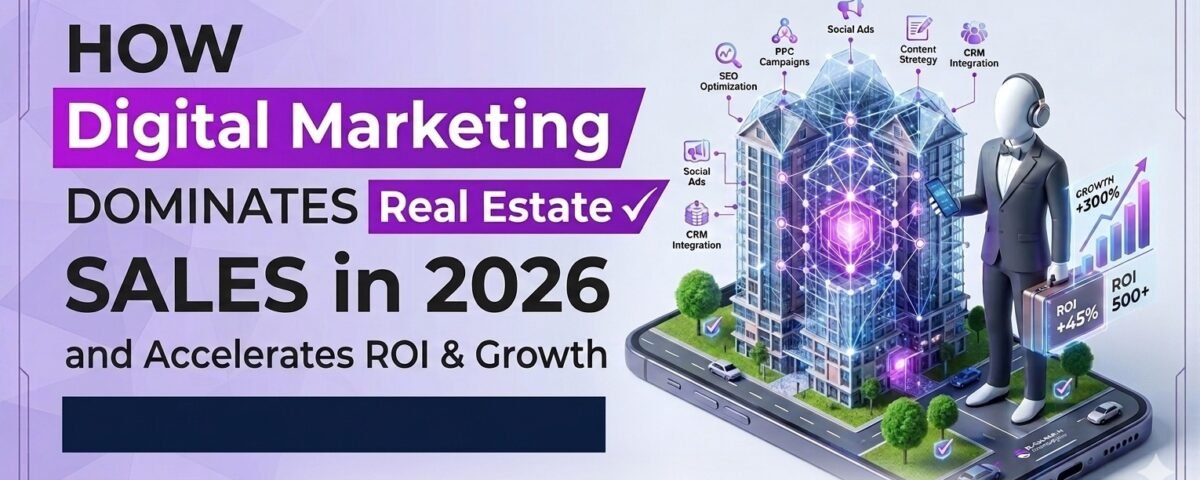
How Digital Marketing Dominates Real Estate Sales in 2026
The real estate industry has historically been defined by its permanence—bricks, mortar, and land. However, as we navigate through 2026, the industry’s success is increasingly defined by something far less tangible: data and digital experiences.
The transition from traditional sales methods to a digital-first ecosystem hasn’t just changed how properties are marketed; it has fundamentally altered the psychology of the homebuyer. In 2026, the “search phase” of the buyer’s journey has moved almost entirely online, with nearly 98% of prospects beginning their journey on a digital interface. For developers, brokers, and individual agents, the ability to harness digital marketing is no longer a “competitive edge”—it is the baseline for survival.
This comprehensive exploration details the core pillars of digital marketing that are driving record-breaking real estate sales in 2026.
1. Hyper-Personalization: The AI-Driven Sales Funnel
In 2026, the “one-size-fits-all” email blast is a relic of a bygone era. Today’s marketing is powered by Predictive Behavioral Analytics.
From Segments to Individuals
Advanced AI algorithms now analyze thousands of data points—ranging from a user’s recent LinkedIn promotion to their browsing history on interior design blogs. When a prospect lands on a real estate portal, the system doesn’t just show them “houses.” It shows them a curated gallery based on their “lifestyle footprint.”
- The Scenario: A young professional who frequently orders high-end vegan takeout and follows urban gardening influencers will be served ads for condos featuring “farm-to-table” communal spaces and LEED-certified kitchens.
- The Result: This hyper-relevance reduces “bounce rates” and increases the conversion of casual browsers into qualified leads by over 40% compared to five years ago.
Predictive Lead Scoring
Modern CRMs (Customer Relationship Management systems) in 2026 do more than store phone numbers. They act as “Digital Detectives.” By tracking how many times a lead views a specific floor plan or downloads a tax benefit guide, the AI assigns a Propensity Score. High-scoring leads are instantly routed to a human agent for a personal call, while lower-scoring leads are entered into automated, educational “nurture loops.”
2. Immersive Reality: Closing the Gap Between Vision and Reality
The biggest friction point in real estate has always been the physical limitation of “being there.” In 2026, Extended Reality (XR)—which encompasses Virtual Reality (VR), Augmented Reality (AR), and Mixed Reality (MR)—has effectively deleted the barrier of distance.
Interactive Virtual Staging
Physical staging is slow, expensive, and rigid. In 2026, tools powered by models like Nano Banana 2 allow for Dynamic Digital Staging.
Imagine a buyer wearing a lightweight AR headset while standing in a cold, empty concrete shell of a new development. With a voice command, they can:
- Toggle Styles: Instantly switch the room from “Minimalist Zen” to “Victorian Opulence.”
- Adjust Layouts: Move a virtual wall to see if an open-plan kitchen suits their lifestyle better.
- View “Time-of-Day” Lighting: Simulate exactly how the morning sun will hit the breakfast nook on a Tuesday in November.
The Rise of the Global “Sight-Unseen” Buyer
In 2026, a significant portion of luxury and investment sales are completed without the buyer ever setting foot on the property. High-fidelity VR tours provide a 1:1 scale experience that is so accurate it carries legal weight in some jurisdictions as a “truthful representation” of the asset.
3. The New SEO: Micro-Local Authority and Voice Search
The days of fighting for the keyword “homes for sale in [City]” are over. In 2026, the battle is won in the long-tail and the micro-local.
The “Neighborhood Mayor” Strategy
Buyers are no longer just buying a house; they are buying a 15-minute city experience. Real estate marketing now focuses on “Niche Content Silos.” Successful agents are creating high-value content around:
- Micro-demographics: “The best child-friendly streets in the West End with the shortest walk to the subway.”
- Infrastructure Insights: “How the upcoming 2027 Green Line expansion will impact property values in District 4.”
- Lifestyle Reports: Video interviews with local baristas, school principals, and park rangers.
Voice and Conversational Search
With the ubiquity of AI home assistants, search queries have become conversational. Instead of typing “2BHK London,” users ask, “Hey Gemini, find me a pet-friendly apartment with a home office near a public park that’s under my budget.” Real estate websites optimized for these long-form, natural language queries are capturing the highest-intent traffic in 2026.
4. Short-Form Video: The Currency of Trust
In an era of deepfakes and overly polished corporate videos, authenticity has become the most valuable currency. Short-form video platforms (TikTok, Reels, Shorts) have replaced the glossy brochure.
The “Raw Walkthrough”
Buyers in 2026 are wary of professional wide-angle photography that makes a closet look like a ballroom. They gravitate toward “The Raw Walkthrough”—a smartphone-shot, unedited tour where an agent points out both the beautiful sunlight and the slightly narrow staircase. This radical transparency builds immediate trust, which is the shortest path to a closed sale.
Social Proof 2.0
Traditional testimonials are now replaced by “Vlog-style Success Stories.” Seeing a real family document their moving day and their first week in a new neighborhood provides more social proof than a thousand written reviews. These videos are often used in Retargeting Ads, appearing to prospects who have visited a listing but haven’t yet booked a viewing.
5. Automation and the “Always-On” Agent
In 2026, the consumer’s expectation for speed is absolute. If a lead isn’t acknowledged within 90 seconds, the “Mental Lead Decay” begins.
Intelligent Concierges
AI-driven chatbots in 2026 are indistinguishable from human assistants in their initial interactions. They don’t just say “We will call you back.” They can:
- Pull up real-time availability.
- Answer complex questions about zoning laws or school ratings.
- Conduct initial financial “soft-vetting.”
- Schedule a physical or virtual tour directly into the agent’s calendar.
The “Ghost” Salesman: Automated Nurturing
Real estate is a long-consideration purchase. Digital marketing allows for automated “drip campaigns” that feel personal. If a buyer looked at a waterfront property but didn’t buy, the system will automatically send them a curated article six months later titled: “5 Reasons Why Waterfront Property Values in [Area] Are Projected to Rise in 2027.” This keeps the brand top-of-mind without the agent having to lift a finger.
6. The Ethics of Data: Privacy as a Selling Point
As we move through 2026, data privacy has shifted from a legal hurdle to a marketing advantage. With the death of third-party cookies, the most successful real estate firms are those that cultivate First-Party Data.
The Value Exchange
To get a buyer’s data, you must provide “Elite Value.” Agents are now using:
- Proprietary Market AI: Offering users access to an AI tool that predicts the future resale value of their current home.
- Early Access Clubs: A “members-only” digital portal where new listings appear 48 hours before they hit mass-market aggregators like Zillow or REA.
By being transparent about data usage and providing clear value in return, real estate brands are building “Fortress Databases” that are immune to the algorithm changes of Big Tech.
7. Strategic Social Media: Community over Follower Count
In 2026, the “influencer agent” has evolved. It’s no longer about how many followers you have, but about the Engagement Rate within a specific community.
Digital Community Building
Developers are now launching Discord servers or private Facebook Groups for specific housing projects before construction even begins. This allows future residents to meet, discuss interior design, and plan community events.
- The Marketing Angle: This creates a “Clubhouse Effect.” When outsiders see a thriving, engaged digital community of future residents, the “Fear of Missing Out” (FOMO) drives rapid sales of the remaining units.
Conclusion: The Integrated Ecosystem
The real estate landscape of 2026 is no longer a collection of disparate parts. You cannot have a “siloed” social media strategy that doesn’t talk to your CRM, and you cannot have a VR tour that isn’t optimized for mobile SEO.
To boost sales in 2026, real estate professionals must view digital marketing as a Seamless Ecosystem:
- Attract via Micro-Local SEO and Short-Form Video.
- Engage via Hyper-Personalized AI Content.
- Convert via Immersive VR Experiences.
- Retain via Automated Lead Nurturing and Community Building.
The agents and developers who thrive this year are the ones who understand that while the house is the product, the digital journey is the service. By reducing friction, increasing transparency, and providing value at every digital touchpoint, the real estate industry is seeing shorter sales cycles and higher customer satisfaction than ever before.
Comparison: Real Estate Marketing (2021 vs. 2026)
| Feature | 2021 Approach | 2026 Approach |
| Lead Generation | Facebook Lead Forms | AI-Powered Behavioral Targeting |
| Property Tours | Sunday Open Houses | 24/7 VR & AR On-Demand Tours |
| Content Strategy | High-Res Photography | Raw, Authentic Short-Form Video |
| Customer Interaction | Email/Phone (Office Hours) | 24/7 Multi-Lingual AI Concierge |
| Staging | Physical Furniture Rental | AI-Dynamic Virtual Staging (Nano Banana 2) |
| Data Usage | Third-Party Cookies | First-Party “Value Exchange” Data |
| Search | Broad Keyword SEO | Micro-Local & Conversational Voice Search |
