
Website Design and Development in India: A Complete Guide for Businesses in 2026
October 21, 2026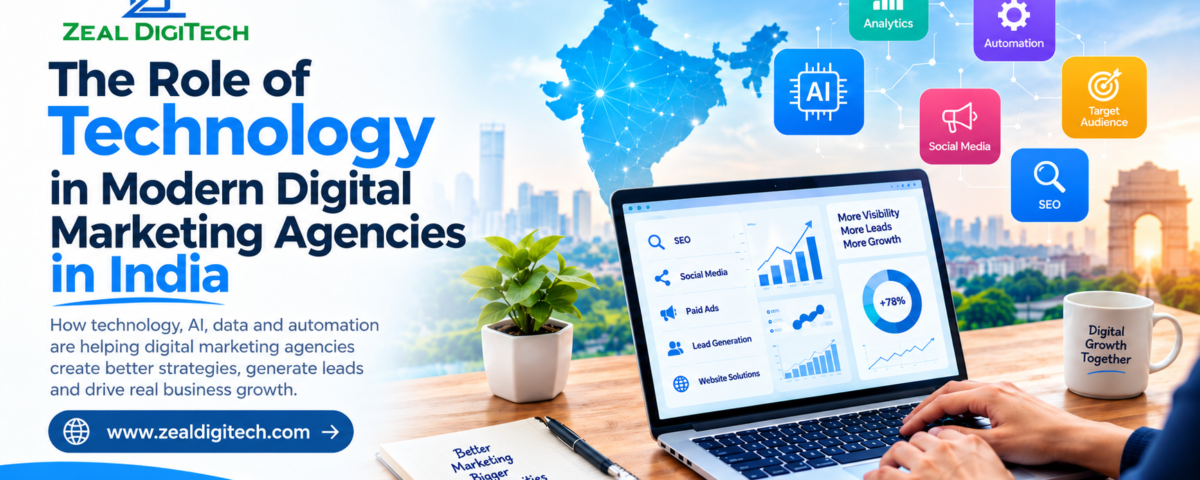
Introduction
The way businesses reach customers has changed significantly over the last few years. People now discover brands through Google searches, social media platforms, online videos, websites, and digital advertisements. For businesses in India, having an online presence is no longer enough. They need the right strategy, useful content, and technology to connect with potential customers and turn interest into sales.
This is where modern digital marketing agencies play an important role. Technology helps agencies understand customer behaviour, improve advertising campaigns, create relevant content, and measure marketing performance more effectively.
From artificial intelligence (AI) and marketing automation to search engine optimisation (SEO) and data analytics, digital tools have become an essential part of everyday marketing activities.
For businesses looking to build a stronger online presence, Zeal DigiTech focuses on digital marketing solutions that help brands improve visibility, connect with their target audience, and generate quality leads.
In this article, we will explore how technology is transforming digital marketing agencies in India and why it matters for businesses of different sizes.
1. Artificial Intelligence Is Changing Digital Marketing
Artificial intelligence has become an important tool for modern digital marketing agencies. It helps marketing teams research topics, understand customer preferences, develop content ideas, and analyse campaign performance.
Instead of spending hours on repetitive tasks, marketers can use AI-powered tools to speed up research and prepare initial drafts. These tools can also help identify patterns in customer behaviour and suggest areas where a campaign may need improvement.
For example, an agency promoting a local service business can use AI to explore common customer questions, generate blog topic ideas, and develop different advertising messages for testing.
However, technology alone cannot create a successful marketing strategy. AI-generated content still needs human editing, fact-checking, and a clear understanding of the target audience.
The best results come when marketers combine technological efficiency with creativity, experience, and genuine customer insight.
2. Data Analytics Helps Agencies Make Better Decisions
Successful digital marketing is not just about publishing content or running advertisements. Businesses also need to understand what is working and where their marketing budget is going.
Data analytics tools help digital marketing agencies track important performance indicators, including website traffic, clicks, enquiries, conversions, and customer engagement.
For instance, a business may receive thousands of website visitors but very few enquiries. By analysing visitor behaviour, an agency can investigate possible reasons, such as confusing website navigation, slow-loading pages, weak calls to action, or irrelevant traffic.
Tools such as Google Analytics 4, Google Search Console, and advertising dashboards help marketers evaluate performance and identify opportunities for improvement.
Data-driven marketing offers several advantages:
- It helps identify which channels attract potential customers.
- It makes campaign performance easier to measure.
- It helps businesses understand how users interact with their websites.
- It supports better decisions about advertising budgets.
- It highlights areas where website and content improvements may be needed.
For modern digital marketing agencies in India, the real value of analytics lies in turning raw numbers into practical decisions that support business goals.
3. Marketing Automation Saves Time and Improves Efficiency
Marketing automation allows businesses to manage repetitive marketing tasks with less manual effort. It can support email campaigns, lead follow-ups, customer segmentation, and scheduled communications.
Consider a business that receives enquiries through its website, social media accounts, and paid advertisements. Without a proper process, some enquiries may go unanswered, especially during busy periods.
With suitable automation tools, the business can organise incoming leads, send an initial acknowledgement, assign enquiries to the relevant team, and schedule follow-up reminders.
This helps create a more organised customer journey.
Automation can also support email marketing by sending relevant messages based on customer interests or previous interactions. For example, someone who downloads a service brochure may receive a follow-up email with additional information.
However, automated communication should still feel useful and personal. Sending too many messages or contacting people without appropriate permission can damage customer trust.
A reliable digital marketing agency helps businesses choose suitable tools and build workflows that support communication without making it feel mechanical.
4. SEO Technology Improves Online Visibility
Search engine optimisation remains an important part of digital marketing because customers frequently use search engines to find products, services, and solutions.
Modern SEO involves much more than adding keywords to a webpage. Agencies need to understand search intent, website performance, technical issues, content quality, and competition.
SEO tools help marketers research keywords, review competitor content, identify technical problems, and monitor changes in search visibility.
For example, a business offering website development services may want to reach people searching for terms such as “custom website designing services” or “digital marketing agency near me”.
An effective SEO strategy involves understanding what these searchers need and creating useful pages that answer their questions.
Technology also helps agencies monitor:
- Keyword rankings and organic search performance.
- Website indexing and crawling issues.
- Page speed and mobile usability.
- Internal links and website structure.
- Search queries that bring visitors to a website.
Search behaviour is also evolving as people increasingly encounter AI-generated answers and conversational search experiences. This makes it useful for agencies to create clear, well-organised content that directly answers customer questions.
For businesses working with Zeal DigiTech, SEO can form part of a broader digital marketing strategy focused on improving search visibility and attracting relevant visitors.
5. Social Media Management Tools Make Campaigns More Effective
Social media has become an important channel for businesses to introduce their products, share updates, build relationships, and attract potential customers.
Managing several platforms manually can be time-consuming. Social media management tools help agencies plan content calendars, schedule posts, monitor engagement, and review performance from a more organised workflow.
These tools also help marketers identify which formats perform well with different audiences. For example, short-form videos may work well for product demonstrations, while informative carousels can help explain a service or answer common questions.
Technology supports social media marketing through:
- Content scheduling and publishing.
- Engagement and performance tracking.
- Audience research and trend monitoring.
- Creative testing and content planning.
- Reporting across multiple social media platforms.
Still, effective social media marketing requires more than consistent posting. Businesses need a recognisable brand voice, relevant content, and regular interaction with their audience.
A modern digital marketing agency combines social media tools with creative planning to help businesses maintain consistency while keeping their communication natural and relatable.
6. Paid Advertising Technology Helps Businesses Reach the Right Audience
Digital advertising platforms give businesses access to targeting, bidding, conversion tracking, and campaign optimisation features.
Google Ads can help businesses reach people actively searching for particular products or services. Meta advertising can help brands introduce their offerings to relevant audiences across Facebook and Instagram.
Technology enables agencies to test different headlines, visuals, audience groups, and landing pages. The resulting data can help marketers understand which combinations are producing useful results.
For example, a company offering professional services may run separate campaigns for website development and lead generation. Tracking enquiries from each campaign can help the agency assess which service attracts more relevant prospects.
Important considerations include:
- Selecting campaign objectives that match business goals.
- Tracking meaningful conversions rather than clicks alone.
- Testing different advertisements and landing pages.
- Monitoring cost per lead and lead quality.
- Reviewing budgets and campaign performance regularly.
Automated bidding and campaign features can simplify parts of advertising management, but they still depend on suitable conversion data, relevant creative assets, and sensible campaign settings.
Technology can improve decision-making, but it cannot guarantee sales or quality leads without an effective strategy and a strong offering.
7. Website Technology Creates a Better Customer Experience
A business website is often the first detailed introduction a potential customer has to a brand. If the website is slow, difficult to navigate, or confusing on mobile devices, visitors may leave before making an enquiry.
Modern website development tools help agencies build responsive websites that work across different screen sizes. They also support improvements in page speed, navigation, accessibility, and website security.
A well-designed website should make it easy for visitors to understand what a business offers and what they should do next.
For example, a service website can use clear service descriptions, relevant project examples, contact forms, and visible calls to action to guide visitors towards making an enquiry.
Useful website improvements include:
- Mobile-friendly layouts and readable text.
- Fast-loading pages and optimised images.
- Clear service pages and navigation menus.
- Simple enquiry forms and contact details.
- Secure connections and reliable hosting.
- Search-friendly website structure.
At Zeal DigiTech, website solutions can complement digital marketing activities by providing businesses with a platform where potential customers can learn about their services and take the next step.
8. Customer Relationship Management Helps Convert Leads
Generating enquiries is only one part of marketing. Businesses also need a reliable way to manage those enquiries and maintain communication with potential customers.
Customer relationship management (CRM) systems help organise contact information, record conversations, track lead stages, and manage follow-up activities.
For example, a business may classify incoming leads as new enquiries, contacted prospects, qualified leads, and converted customers. This gives the sales team a clearer view of which opportunities require attention.
When CRM data is connected appropriately with marketing platforms, agencies can better understand which campaigns are contributing to meaningful business outcomes.
A well-managed CRM process can help businesses:
- Reduce the risk of missed enquiries.
- Improve communication between marketing and sales teams.
- Track lead progress through the sales process.
- Identify common reasons for lost opportunities.
- Understand which marketing channels attract valuable customers.
Technology is most effective when the people handling leads also follow a consistent process. Even a well-designed marketing campaign may underperform if enquiries are not answered promptly.
9. AI-Powered Search Is Expanding the Role of SEO
The way people discover information online is changing. Alongside traditional search results, users may now find information through AI-powered search features and conversational assistants.
This has encouraged marketers to pay greater attention to answer-focused content and generative engine optimisation (GEO), which aims to improve a brand’s chances of being surfaced in AI-generated answers.
Although SEO and GEO are not identical, they share several useful principles: accurate information, clear explanations, helpful headings, credible sources, and content that genuinely answers users’ questions.
Businesses can prepare by publishing detailed service pages, informative blogs, frequently asked questions, and original insights relevant to their industry.
For example, rather than publishing a page that simply repeats the phrase “digital marketing agency in India”, a business can explain how digital marketing works, which services it provides, how campaigns are measured, and what customers should consider when choosing an agency.
No agency can guarantee inclusion in every AI-generated answer. The practical goal is to build a trustworthy online presence that is useful to both people and search systems.
10. Data Privacy and Responsible Technology Use Matter
As digital marketing becomes more data-driven, businesses must take customer privacy seriously.
Marketing teams should understand how customer information is collected, stored, accessed, and used. They should also review the privacy requirements applicable to their business, including relevant Indian data protection laws and platform policies.
Responsible technology use involves collecting only the information needed for legitimate purposes, obtaining appropriate consent where required, and protecting customer records.
Agencies should also review AI-generated content for factual errors, misleading claims, and accidental disclosure of confidential information.
These practices help businesses build long-term trust with customers while reducing avoidable risks.
Technology should make marketing more effective without compromising the privacy, safety, or confidence of the people it serves.
11. How to Choose a Technology-Driven Digital Marketing Agency in India
With so many agencies offering online marketing services, businesses should look beyond the number of tools an agency uses.
The right partner should understand the business, its customers, its competition, and its growth objectives. Technology should support that understanding rather than replace it.
Before choosing an agency, consider the following questions:
- Does it understand your business goals? Marketing activities should connect with objectives such as brand awareness, enquiries, or sales.
- Does it use measurable performance indicators? Reports should explain results in terms that are meaningful to your business.
- Does it offer relevant services? SEO, social media marketing, paid advertising, lead generation, and website solutions should match your requirements.
- Does it communicate clearly? You should understand what work is being done and why.
- Does it combine technology with human expertise? Tools are useful, but strategy, creativity, and customer understanding remain essential.
Businesses should also ask about reporting frequency, data access, campaign ownership, and how success will be evaluated.
If you are looking for digital marketing support, Zeal DigiTech is a place to explore services related to online visibility, branding, lead generation, social media marketing, and website solutions.
Conclusion
Technology has changed how modern digital marketing agencies in India plan campaigns, understand audiences, manage leads, and measure results. AI, analytics, automation, SEO tools, advertising platforms, and CRM systems help marketing teams work more efficiently and make better-informed decisions.
However, technology alone does not create sustainable growth. Businesses still need useful content, clear communication, a strong website, a well-defined target audience, and a consistent marketing strategy.
The most effective approach combines the speed and insights of technology with human creativity, experience, and genuine customer understanding.
For businesses that want to strengthen their online presence and connect with the right audience, working with a suitable digital marketing partner can help bring these elements together.
Explore Zeal DigiTech to learn more about digital marketing and website solutions for your business.
Frequently Asked Questions (FAQs)
1. How does technology help digital marketing agencies in India?
Technology helps agencies analyse customer behaviour, manage advertising campaigns, improve SEO, automate repetitive tasks, and measure marketing performance.
2. Why is AI important in digital marketing?
AI can support content research, campaign analysis, audience insights, and marketing automation. Human review remains important for accuracy, creativity, and brand consistency.
3. Which digital marketing tools do agencies commonly use?
Common tools include Google Analytics 4, Google Search Console, Google Ads, social media management platforms, SEO research tools, CRM systems, and AI-assisted content tools.
4. Can technology help businesses generate more leads?
Yes. Technology can help businesses reach relevant audiences, improve landing pages, track conversions, and manage enquiries. Actual results depend on the strategy, budget, offer, and follow-up process.
5. How can I choose a digital marketing agency for my business?
Look for an agency that understands your goals, offers relevant services, explains its strategy clearly, measures meaningful results, and uses technology responsibly.