The Role of Technology in Modern Digital Marketing Agencies in India
October 28, 2026
15 Google AI Tools You Should Know in 2026 to Work Smarter and Save Time
November 20, 2026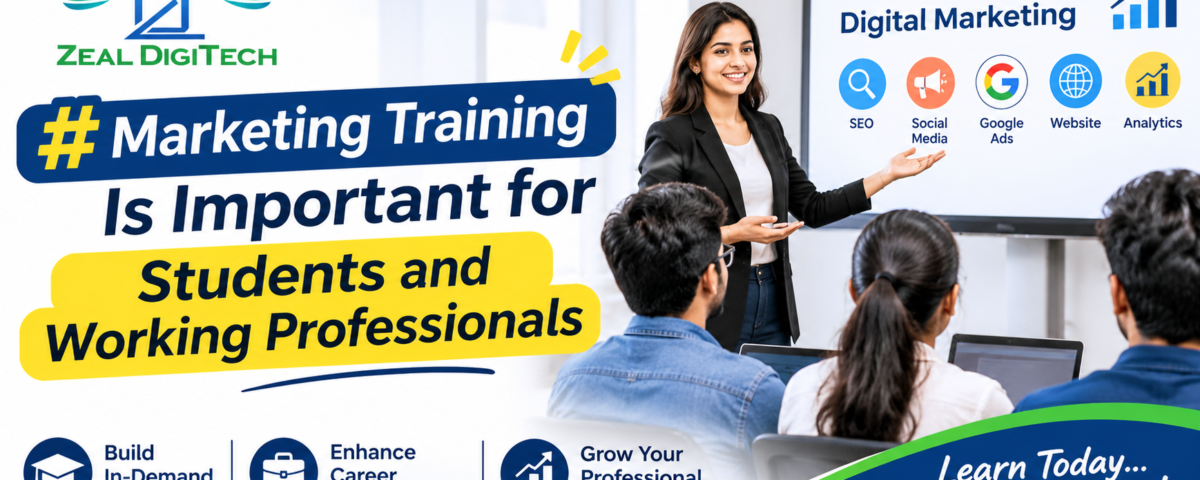
The way businesses connect with customers has changed significantly over the last few years. Today, people search on Google before purchasing products, discover brands through social media, watch online advertisements, and compare services through websites. As a result, digital marketing has become an important part of how businesses attract customers and grow.
This change has also created new career opportunities for students, fresh graduates, job seekers, and working professionals. Companies are looking for people who understand online marketing, customer behaviour, social media platforms, search engines, and digital advertising.
However, simply using Instagram, Facebook, or Google is not enough to build a career in this field. You need to understand how these platforms work from a marketing perspective. This is where digital marketing training becomes valuable.
Whether you are a student planning your future career or a working professional looking to improve your skills, learning digital marketing can help you understand the online business world and explore new professional opportunities.
In this blog, we will discuss why digital marketing training is important, what skills you can learn, and how it can benefit both students and working professionals.
What Is Digital Marketing Training?
Digital marketing training is a learning process that teaches you how to promote products, services, and businesses through online platforms.
It covers different marketing techniques that help businesses reach their target audience, generate leads, increase brand awareness, and improve online visibility.
Unlike traditional marketing, which mainly uses newspapers, television, radio, and printed advertisements, digital marketing focuses on online channels.
A professional digital marketing training programme generally covers:
- Search Engine Optimization (SEO): Learning how to improve website visibility on search engines like Google.
- Social Media Marketing: Promoting businesses through platforms such as Instagram, Facebook, LinkedIn, and YouTube.
- Google Ads: Creating paid advertising campaigns to reach potential customers.
- Content Marketing: Developing useful blogs, articles, videos, and other content to attract audiences.
- Email Marketing: Connecting with customers through targeted email campaigns.
- Website Management: Understanding website structure, user experience, and basic website optimization.
- Analytics and Reporting: Measuring website traffic, campaign performance, and marketing results.
These skills help learners understand how digital marketing works in real business situations.
1. Why Is Digital Marketing Training Important for Students?
Choosing the right career after school or college can be challenging. Many students have theoretical knowledge but limited practical experience with industry tools and business requirements.
Digital marketing training gives students an opportunity to explore a growing professional field while developing skills that can be useful across different industries.
Here are some important reasons why students should consider learning digital marketing.
A. Opens New Career Opportunities
Digital marketing offers different career options for students with different interests and educational backgrounds.
After completing suitable training and gaining practical experience, learners can explore roles such as:
- SEO Executive
- Social Media Manager
- Digital Marketing Executive
- Google Ads Specialist
- Content Marketing Executive
- Email Marketing Specialist
- Website Marketing Executive
These opportunities are available across industries, including education, healthcare, e-commerce, real estate, technology, and hospitality.
Students can choose a career path based on their interests and gradually develop expertise in a particular area.
B. Develops Practical Skills Alongside Education
Classroom education provides important theoretical knowledge, but employers also look for practical skills.
A good digital marketing course introduces students to real marketing activities, such as keyword research, website optimization, social media planning, and advertising campaign management.
For example, students can learn how to:
- Find relevant keywords for a website.
- Create a social media content calendar.
- Understand Google Search Console.
- Prepare basic SEO reports.
- Design and manage advertising campaigns.
- Analyse website visitors and user behaviour.
Working on these activities helps students understand how marketing strategies are implemented in real situations.
C. Helps Students Become Freelancers
Not every student wants to follow a traditional job path. Some prefer independent work and want to offer services to clients.
Digital marketing skills can help students explore freelancing opportunities.
For example, a student who understands social media marketing can help a small business manage its Instagram and Facebook pages. Someone with SEO knowledge can assist businesses with keyword research, website content, and basic optimization.
Freelancing also helps students improve communication, client management, time management, and problem-solving skills.
However, building a successful freelancing career takes consistent learning, practical experience, and the ability to deliver quality work.
D. Encourages Entrepreneurship
Students who want to start their own businesses can also benefit from digital marketing knowledge.
Imagine starting an online clothing store, a bakery, or a small service business. You need customers to discover your products and understand what makes your business different.
Digital marketing helps entrepreneurs learn how to:
- Promote products on social media.
- Create an online presence through a website.
- Reach potential customers through advertisements.
- Improve visibility on Google.
- Build relationships with customers.
- Generate enquiries and sales opportunities.
Instead of depending entirely on external marketing agencies, business owners with basic digital marketing knowledge can understand their marketing activities and make better decisions.
2. Why Is Digital Marketing Training Important for Working Professionals?
Learning does not have to stop after getting a job. Technology, customer expectations, and business strategies continue to change.
Working professionals who upgrade their skills can stay more adaptable and explore opportunities within their current organisations or in other industries.
Here is how digital marketing training can benefit working professionals.
A. Helps Professionals Upgrade Their Skills
Many traditional marketing activities are now connected with digital platforms.
Professionals working in sales, advertising, business development, public relations, or marketing can benefit from understanding online marketing strategies.
For example, a sales professional can learn how businesses generate leads through Google Ads and social media campaigns. A traditional marketing executive can understand how SEO and content marketing contribute to brand visibility.
Learning these skills helps professionals understand the connection between marketing activities and business growth.
B. Creates Opportunities for Career Growth
Digital marketing knowledge can help professionals prepare for new responsibilities and explore specialised roles.
For example, someone working as a marketing executive may develop additional expertise in SEO, paid advertising, or social media management.
With relevant experience and demonstrated skills, they may explore positions such as:
- Digital Marketing Manager
- SEO Manager
- Performance Marketing Specialist
- Social Media Strategist
- PPC Campaign Manager
- Digital Marketing Consultant
Career growth depends on practical knowledge, experience, performance, and the requirements of individual employers. Training provides a foundation for developing these capabilities.
C. Helps Professionals Understand Online Customers
Modern customers interact with businesses through websites, social media, search engines, and online advertisements.
Understanding this behaviour is important for professionals involved in sales, marketing, and customer relationships.
Digital marketing training introduces concepts such as customer targeting, audience segmentation, customer journeys, and campaign performance.
For instance, a business development professional can understand how a customer discovers a brand through Google, visits its website, checks social media profiles, and finally submits an enquiry.
This knowledge can help professionals understand customer expectations and improve their approach to business communication.
D. Supports Career Changes
Sometimes professionals want to move into a different industry or explore a new career direction.
Digital marketing can be one of the fields worth considering because its skills are relevant to many types of businesses.
A person from a non-marketing background can start by learning SEO, social media marketing, content creation, or paid advertising.
They can gradually build practical knowledge through projects, internships, and independent work.
A career transition requires patience and continuous practice, but structured training can make the learning process easier.
3. Top Skills You Can Learn Through Digital Marketing Training
One of the biggest advantages of digital marketing training is that it covers multiple skills instead of focusing on just one platform.
Some of the most useful skills include:
1. Search Engine Optimization (SEO)
SEO teaches you how to improve a website’s visibility in organic search results.
You learn about keyword research, on-page SEO, technical SEO, internal linking, content optimization, and website performance.
These skills help you understand how people search for information and how websites can provide relevant answers.
2. Social Media Marketing
Social media marketing focuses on promoting businesses through online platforms.
You learn how to plan posts, understand audience behaviour, create engaging content, manage business pages, and analyse social media performance.
It is particularly useful for businesses that want to build brand awareness and connect with their audience.
3. Google Ads and Paid Advertising
Google Ads training introduces you to paid advertising campaigns that can help businesses reach people searching for relevant products and services.
You learn about campaign structure, keyword targeting, ad creation, budgets, bidding strategies, and conversion tracking.
Practical experience is important because campaign performance depends on targeting, competition, budget, and landing page quality.
4. Content Marketing
Content marketing involves creating helpful and relevant information for a target audience.
This may include blogs, website content, social media posts, videos, and other digital materials.
Good content helps businesses answer customer questions, communicate their expertise, and build trust.
5. Website and Analytics Skills
A website is often an important part of a business’s digital presence.
Training can introduce learners to website structure, basic optimization, user experience, Google Analytics 4, and Google Search Console.
These tools help marketers understand website traffic, user interactions, search performance, and opportunities for improvement.
4. Practical Learning Is More Important Than Just Certificates
When choosing a digital marketing course, students and professionals should look beyond the certificate.
A certificate may show that you have completed a course, but it does not automatically prove that you can manage marketing activities independently.
Practical knowledge is what helps you apply what you have learned.
For example, instead of only studying SEO theory, try optimizing a real website. Instead of simply learning about social media marketing, prepare a content calendar and manage a practice business page.
A quality digital marketing training programme should include:
- Practical assignments and activities.
- Training on relevant digital marketing tools.
- Realistic marketing projects.
- Keyword research and SEO exercises.
- Social media campaign planning.
- Google Ads campaign fundamentals.
- Performance tracking and reporting.
- Guidance on building a professional portfolio.
Working on projects gives learners something meaningful to discuss during interviews and demonstrate to potential clients.
5. How to Choose the Right Digital Marketing Training Institute?
Selecting the right training institute is an important step in your learning journey.
With many online and offline courses available, it is important to compare the training quality, course structure, practical exposure, and learning support before enrolling.
Here are a few things to consider:
- Check the Course Curriculum: Make sure the course covers important areas such as SEO, social media marketing, Google Ads, content marketing, and analytics.
- Focus on Practical Training: Choose a programme that provides hands-on assignments and opportunities to work on actual projects.
- Understand the Trainers’ Experience: Check the trainers’ professional background and experience in digital marketing.
- Ask About Tools and Platforms: Find out whether the training includes practical exposure to industry-relevant tools and platforms.
- Check Learning Support: Ask whether students receive doubt-clearing sessions, project guidance, and feedback.
- Understand Certification Details: Check who issues the certificate and what it represents. Do not assume that every private training certificate is an official government-recognised qualification.
The right programme should help you develop useful skills rather than simply complete a syllabus.
6. Is Digital Marketing a Good Career Option for Beginners?
Yes, digital marketing can be a suitable career option for beginners who are interested in technology, creativity, communication, and business growth.
You do not necessarily need an IT background to start learning digital marketing. People from commerce, arts, science, management, and other educational backgrounds can explore this field.
The important thing is to understand the basics and develop skills through regular practice.
Beginners can start with SEO, social media marketing, and content creation before moving towards specialised areas such as paid advertising, analytics, and marketing automation.
It is also useful to stay updated because digital platforms, advertising features, and search engine practices change over time.
Digital marketing is not a shortcut to guaranteed employment or quick earnings. Like other professional fields, it requires dedication, experience, and continuous improvement.
7. The Growing Importance of AI in Digital Marketing Training
Artificial intelligence is becoming an important part of modern marketing workflows.
Digital marketers can use AI-powered tools to support research, generate content ideas, analyse information, understand audience behaviour, and improve productivity.
However, AI tools cannot replace the need for marketing knowledge and human decision-making.
A marketer still needs to understand customer requirements, verify information, create meaningful strategies, maintain brand consistency, and evaluate campaign results.
That is why learning how to use AI responsibly alongside traditional digital marketing skills can be valuable for students and working professionals.
A future-ready digital marketer should understand both technology and the people behind every purchase decision.
8. Why Choose Zeal DigiTech for Digital Marketing Training?
Choosing a training programme is not just about learning different marketing terms. It is about understanding how digital marketing works in practical business situations.
Zeal DigiTech focuses on digital marketing services and online business growth. Its areas of work include SEO, social media marketing, lead generation, branding, and website solutions.
Learning about these different aspects of digital marketing can help students and working professionals understand how online marketing strategies connect with real business requirements.
If you are planning to develop your digital marketing knowledge, explore the training opportunities available through Zeal DigiTech.
Before enrolling, check the latest course syllabus, training format, practical assignments, certification details, and available support to ensure the programme matches your learning goals.
Visit the official website: https://zealdigitech.com/
Frequently Asked Questions (FAQs)
1. Why is digital marketing training important for students?
Digital marketing training helps students develop practical skills in SEO, social media marketing, Google Ads, content marketing, and analytics. It also introduces them to different career paths, freelancing opportunities, and entrepreneurship.
2. Can working professionals learn digital marketing?
Yes. Working professionals from marketing, sales, business development, and other fields can learn digital marketing to upgrade their skills, understand online customers, and explore new career opportunities.
3. Do I need technical knowledge to learn digital marketing?
No advanced technical knowledge is required to start learning digital marketing. Beginners can start with basic concepts and gradually develop skills in SEO, social media, content creation, and online advertising.
4. How long does it take to learn digital marketing?
The learning duration depends on the course structure, topics covered, and time spent practising. Basic concepts can be learned relatively quickly, but developing professional-level skills requires regular practice and real-world experience.
5. Is a digital marketing certificate useful for getting a job?
A certificate can demonstrate that you have completed a training programme. However, employers also consider practical skills, project experience, communication abilities, and your understanding of digital marketing tools.
6. Which digital marketing skills are best for beginners?
SEO, social media marketing, content marketing, Google Ads fundamentals, and website analytics are useful starting points for beginners.
7. Can I become a freelancer after digital marketing training?
Yes. Digital marketing training can help you develop skills that are useful for freelancing. You can explore services such as SEO, social media management, content creation, and paid advertising after gaining sufficient practical experience.
Conclusion
Digital marketing is no longer limited to people working in advertising or marketing departments. It has become a valuable skill for students, working professionals, entrepreneurs, and individuals who want to understand how businesses grow online.
For students, digital marketing training can introduce new career opportunities, practical skills, and entrepreneurial possibilities. For working professionals, it can support skill development, career transitions, and professional growth.
The key is to choose the right training programme, learn from experienced professionals, practise with relevant tools, and keep improving your knowledge.
If you want to build a career in the digital world, starting your digital marketing learning journey today can be a useful step towards your future.